

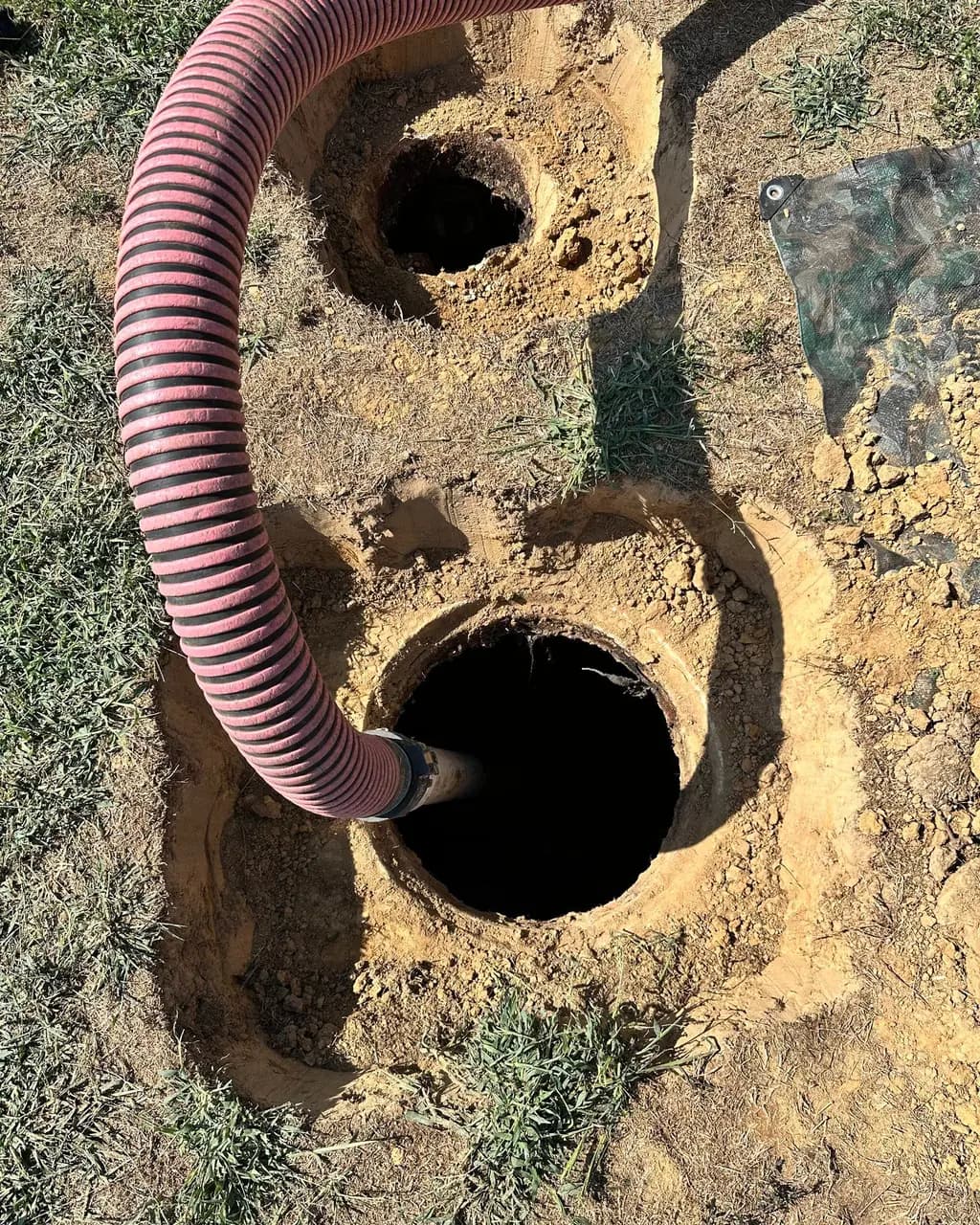
If your septic alarm is going off, the water in your tank is higher than it should be. Cut your water use right now, silence the alarm, and call us at (270) 872-7947. We answer 24/7, emergency septic service starts from $199, and we're typically on site in 1-2 hours across Paducah, Murray and Mayfield.
That's the short answer. The rest of this page explains what the alarm is telling you, what you can safely check yourself tonight, and what we look at when we get there.
What a septic alarm actually means
A septic alarm is a float switch tied to a light and a buzzer. The float sits inside the tank. When the water rises past a set point, the float tips up and the alarm goes off.
So a septic tank alarm going off is not a reminder that it's time to pump. It's telling you water is coming in faster than it's going out. Something downstream has stopped moving it.
On many Western Kentucky homes, that alarm sits on a pump tank. The pump pushes treated water out to the drain field (the field lines, the buried pipes that soak treated water into the yard). If the pump stops, or the line to the field is blocked, the level keeps rising until the float trips the alarm.
What to do in the first 10 minutes
You don't need tools for any of this.
1. Stop using water. No laundry, no dishwasher, no showers. Flush only when you have to. Every gallon you send down goes into a tank that already can't keep up.
2. Silence the buzzer. Most alarm boxes have a button or switch on the front. Pressing it stops the noise. The light usually stays on. That's normal, and it's how you'll know the problem isn't fixed yet.
3. Look at the breaker. If the pump and the alarm are on separate circuits, a tripped breaker can cut the pump while the alarm keeps working. If you find a tripped breaker for the septic pump, note it and tell us when you call. If it trips again, leave it off.
4. Call us. Tell us when the alarm started, whether it's been raining, and whether any drains in the house are slow. That helps us bring the right equipment.
What not to do: don't open the tank lid and look inside, and don't keep resetting the alarm and going back to normal water use. Turning the buzzer off doesn't lower the water.
Why the alarm went off
When we get to a house with a septic alarm beeping, these are the things we check, roughly in this order.
The pump stopped
The pump is the most common reason the level climbs. It may have lost power, burned out, or be stuck. We check whether it's getting power, whether it runs, and whether it moves water when it does run.
A float is stuck or tangled
There are usually separate floats for "pump on", "pump off" and the alarm. If the "pump on" float is hung up on a cord or the tank wall, the pump never gets the signal to start. Sometimes the alarm float itself is the problem and the level is fine. We can tell which by looking at the actual water level.
The line or filter is blocked
If the pump runs but the level still won't drop, water isn't getting out. That points to a clogged effluent filter (a screen that keeps solids from leaving the tank) or a blocked line between the tank and the field. Effluent filter cleaning or replacement starts from $99 with us.
A blocked line is something we see a lot. In September, Todd Jackson's tank had been pumped, but the line was still stopped up. Pumping the tank didn't touch the clog. We came back and hydro jetted the line to get it flowing clear. If that sounds like your situation, read why a pumped tank can still back up.
Too much water at once
Several loads of laundry back to back, guests for the weekend, or a long soak of rain can send in more water than the system can move in a short time. If the alarm clears on its own after a few hours of light use, this may be all it was. If it keeps coming back, something else is going on.
Rain and a wet field
When the field lines are already soaked from heavy rain, they can't take more water. The pump runs, but the water has nowhere to go. An alarm that only goes off after big storms often points to the field, not the pump.
The tank is full
If the tank hasn't been pumped in a long while, solids build up and take space the water needs. Septic tank pumping with us starts from $449. A full septic cleaning starts from $249 and goes further: we remove settled solids, rinse the tank, check the baffles (the tees inside the tank that keep solids from leaving it) and the effluent filter, and look at the drain field.
What happens when we arrive
We start by finding out where the water level is and why it's there. Then we tell you what we found and what it costs before we fix anything.
- If the lid is buried and nobody knows where the tank is, we locate it first. Septic tank locating starts from $150.
- If it's a pump, float or wiring problem, that's a repair. Septic system repair starts from $249.
- If the line or filter is blocked, we clear it.
- If the tank is full, we pump or clean it.
- If the field is the problem, we tell you straight. Sometimes a repair is enough. Sometimes the field needs replacing, and that's quoted after we've looked at it.
You speak to the owners directly, not a call center. Repairs come with a warranty covering parts and labor. Terms vary by repair type, and we explain them before work starts.
Don't wait until Monday
An alarm at 9 p.m. on a Saturday is still an alarm. If water keeps coming in and nothing is moving it out, the next place it goes is back up into the house.
That's why we keep the phone on. One customer, Sarah, put it this way: "Called them on a Saturday for a full septic tank and they got me in that very same day." Judy had a septic problem over a weekend: "We had a septic problem over the past weekend and called Lucas on Sunday. He responded very quickly and the problem was taken care of Monday."
Our 24/7 emergency septic service covers alarms, backups and overflows. We work across McCracken, Graves, Marshall, Ballard, Fulton and Hickman Counties. Check our service areas to see the towns we cover.
Make the next call easier
Many alarm calls take longer than they need to because the tank lid is buried. If you have to dig every time, every visit starts with a shovel. A riser brings the lid up to ground level, so the next pump-out, filter check or alarm call starts by lifting a lid. See what septic tank riser installation costs; ours start from $220.
Questions people ask
Why does my septic alarm keep going off?
An alarm that keeps coming back means the cause hasn't been fixed. Pumping the tank lowers the level for a while, but if the pump, a float, the filter, the line or the field is the real problem, the level climbs again. If yours keeps returning, have the whole system checked, not just pumped. Our septic system repair visit starts with finding that cause.
Is it safe to use the toilet when the septic alarm is on?
Use as little water as you can until it's checked. An occasional flush is usually fine. Laundry, showers and the dishwasher can wait. The more water you add, the closer the tank gets to backing up into the house.
What are the early signs a septic system is failing?
The early signs a septic system is failing are slow drains, gurgling pipes, a sewage smell, and wet or extra-green patches over the field lines. An alarm that comes back after pumping is another. Any one of these is worth a call.
Get your alarm checked tonight
If your septic alarm is going off, cut back on water and call us at (270) 872-7947. We answer 24/7, emergency service starts from $199, and we're typically there in 1-2 hours across Paducah, Murray and Mayfield. For anything that can wait until business hours, get a free quote.